
China displayed a range of new weapons at a military parade, including laser weapons, nuclear ballistic missiles, giant underwater drones, and fifth-generation aircraft.

The Supreme Court has ordered the removal of all stray dogs from Delhi-NCR streets following concerns about rabies and dog bite incidents, particularly those involving children. The court criticized animal lovers and activists, questioning their ability to compensate for the loss of life due to rabies.
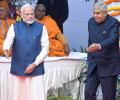
The RSS which catapulted Jagdeep Dhankar to national prominence after 21 years of hibernation could not come to his rescue when BJP higher ups decided to seek his resignation, points out Prakash Bhandari.

A court in Kerala has discharged five people in a case alleging the trafficking of three underage girls for domestic work, ruling that there was no evidence of threats, coercion or exploitation.
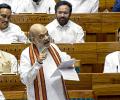
'This type of comprehensive legislation has never been introduced before in Parliament's history.' 'A bill that simultaneously affects ministers, chief ministers, and the prime minister represents completely uncharted Constitutional territory.' 'Throughout our nation's legislative history, the established policy has consistently held that public office holders should face punishment only after receiving conviction from a competent court of law. Without this safeguard, we risk systematic destabilisation, and our federal structure would face complete collapse.' 'Any central government could potentially deploy this legislation against state governments they oppose politically. This represents the most frightening prospect and dangerous possibility that these bills create.'

Following a directive from the Supreme Court, the AIFF has been asked not to negotiate new terms of the MRA with FSDL, the apex governing body's commercial partner running the ISL, until a final judgment is delivered in the AIFF draft constitution case.

The Centre told the bench that compensation to the beneficiaries was already paid and the land was acquired but subsequently, one person, on the strength of a power of attorney, filed a reference case.
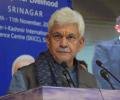
Lieutenant Governor Manoj Sinha's power to nominate five members to the Jammu and Kashmir Assembly was at the centre of a political and legal debate on the eve of vote count, with the Congress and regional parties the National Conference and the People's Democratic Party on Monday opposing any such move during government formation.

Sports Minister Mansukh Mandaviya said the Sports Bill is a key reform aimed at building a "transparent, accountable and world-class sports ecosystem" in India.
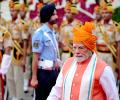
'The Election Commission's involvement in the avoidable SIR controversy has carried a message down to the last voter -- who just does not like it,' observes N Sathiya Moorthy.
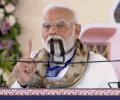
Prime Minister Narendra Modi on Friday sounded the poll bugle in Bihar, where assembly elections are due this year, calling for 'an NDA government, once again', which would protect the state from the 'evil intentions' of the Rashtriya Janata Dal-Congress combine.

Underscoring the 'presumption of genuineness' of Aadhaar and voter ID, the Supreme Court on Monday refused to stay the publication of draft electoral rolls in poll-bound Bihar and said it would once and for all decide pleas against Election Commission's special intensive revision (SIR) of electoral rolls.

When the government chooses to either ignore or use identity documents only when it suits them, it shakes people's sense of stability, notes Shyam G Menon.

Bhutia and Chaubey have shared a history of verbal spats, with the former frequently questioning Chaubey's leadership, even calling the AIFF a "circus"

Congress leader Rahul Gandhi has launched a 'Voter Adhikar Yatra' in Bihar to advocate for fair elections and protect voting rights, alleging irregularities in electoral rolls and accusing the BJP of attempting to disenfranchise voters.
The final NRC, a list of Indian citizens residing in Assam, was released in 2019 by excluding 19,06,657 people. However, it has not been notified by the Registrar General of India, leaving the controversial document without any official validity.
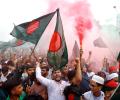
'Pakistan will also try to turn Bangladesh into a base for terrorist attacks on India.'
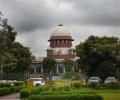
A bench of Justices Sudhanshu Dhulia and Joymalya Bagchi, however, questioned the timing of the exercise, besides offering its prima facie view that Aadhaar card, voter ID card and ration cards could be considered during the SIR in Bihar.
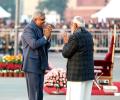
The BJP had no option but to get Jagdeep Dhankhar out of its way for the sake of the Modi government's stability, reveals Sheela Bhatt, the legendary political journalist.

In more than one way, it's a setback for the DMK and Chief Minister Stalin in political terms. The electoral fall-out, if any, will have to wait until the next summer, only when assembly elections are due in the state, explains N Sathiya Moorthy.
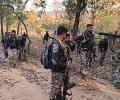
Referring to the enactment of the Chhattisgarh Auxiliary Armed Police Force Act, 2011 which created a trained force to aid and assist the security forces in maintaining law and order in the state, the bench said in its view it cannot be said to be an act of contempt of the order of 2011 passed by this court.

The Karnataka High Court has directed suspended JD(S) leader Prajwal Revanna to approach the sessions court for bail in the rape case filed against him. The court clarified that Revanna could return to the HC if necessary, after the lower court considers his plea.
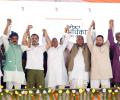
Gandhi alleged that assembly and Lok Sabha polls were being "stolen" across the country and there was a "conspiracy" in Bihar to do the same through the Special Intensive Revision of electoral rolls.

The Supreme Court on Tuesday asked about the "source of power" of the lieutenant governor under the Constitution and the law to nominate 10 aldermen to the Municipal Corporation of Delhi (MCD) without the aid and advice of the elected government.
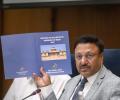
The Supreme Court on Thursday said the Election Commission (EC) is duty bound to act in a fair and legal manner and a person who is weak-kneed before the powers cannot be appointed as an election commissioner.

The Supreme Court dismissed Allahabad High Court judge Yashwant Varma's plea seeking invalidation of a report that found him guilty of misconduct in the cash discovery row.
Speculation swirls in Pakistan regarding potential changes in the political landscape, fueled by rumors of the army chief's possible presidential aspirations and discussions between top civilian and military leaders.

Implementation of sports bill in 6 months, regulation of participation standard safeguard: Mandaviya

The Supreme Court's ruling in the BPSL case exposes deep flaws in the IBC's institutional framework and raises concern about judicial overreach, notes Rajeswari Sengupta.

Khamenei, who has the last word on all state matters and is also the commander in chief of the armed forces, instructed military commanders from the Revolutionary Guards and the army to prepare plans for both an attack and a defence in case the war expands and Israel or the US strike Iran, the officials said.

Union Home Minister Amit Shah has stated that Naxalism, currently confined to just four districts in India, will be completely eradicated by March 31, 2026. He emphasized the crucial role of the Central Reserve Police Force (CRPF), particularly its CoBRA battalion, in achieving this goal. Shah lauded the CRPF's contributions to national security, highlighting their efforts in combating terrorism in Kashmir, maintaining peace in the Northeast, and significantly reducing Naxal violence. He also paid tribute to the CRPF's sacrifices, acknowledging the loss of 2,264 personnel in the line of duty.
In his first address to National Democratic Alliance MPs in over a year, Prime Minister Narendra Modi on Tuesday emphasised its collective identity as a natural and organic alliance, asserting that its journey since its foundation in 1998 is dotted with successes and has many more achievements in store.
BJP and RSS leaders are once again pushing to remove the words 'secular' and 'socialist' from the Constitution's Preamble, showing a deeper effort to change India's identity from a diverse, multi-religious republic to a Hindu-first nation, even though they don't have the numbers in Parliament to officially change the Constitution, observes N Sathiya Moorthy.

Several leaders of the BJP and its allies are of the view that the NDA this time is unlikely to follow the instincts that made it pick Dhankhar and will be more conventional in its search for his successor.
The Maharashtra legislative assembly passed the 'Maharashtra Special Public Security Bill' aimed at preventing unlawful activities of Left Wing Extremist organizations, focusing on urban Naxalism and passive militancy.
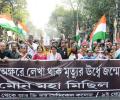
A year after a young woman doctor was raped and murdered in Kolkata, her parents express their disappointment with the investigation and their continued pursuit of justice.
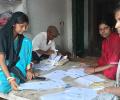
The Election Commission of India (ECI) asserts that major political parties participated in the Special Intensive Revision (SIR) of electoral rolls, deploying booth level agents despite opposing the exercise in the Supreme Court. The ECI defends its authority to conduct the revision to maintain the integrity of elections.

Ruling that Flipkart cannot "escape liability" as "mere intermediary" in an online purchase, a consumer commission here has found the e-commerce platform and television manufacturing company Thomson guilty of deficiency in service after a defective TV was delivered to a customer.
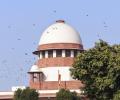
Preventive detention is an extraordinary power in the hands of the state that must be used sparingly, said the Supreme Court as it set aside an order to detain a man indulging in money lending in Kerala.

'Notwithstanding the seriousness of the allegations made, every accused had a right to a speedy trial and the court had to take into account long periods of incarceration without trial as an additional consideration for grant of bail.'
